
Title generated by Chat GPT. Response written by Chat GPT. Reflection written by Autumn Gibbs.
AI Response
In “The Millions of Songs Mashed Into AI-Generated Music,” Alex Reisner explains that music-generating AIs learn by analyzing collections of recordings. The systems break audio into small pieces and detect patterns in sounds, rhythm, structure, and style. They use those patterns to predict what might come next from a prompt. This process can produce music, but it also raises a concern: AI’s ability to create depends on musicians’ work.
Some argue that training is another form of learning. Musicians also listen to songs, study genres, and draw inspiration from other artists. However, AI training happens on a different scale. The article describes four datasets containing more than 21 million tracks, which companies can collect and process without each musician’s knowledge. A person may be influenced by a few songs; a model can analyze vast libraries and generate music for commercial use. That imbalance makes transparency and consent important.
AI-generated music can help people compose without expensive equipment. These possibilities are valuable, but they do not erase the responsibility to respect the people whose recordings teach the systems. Developers should disclose the music used for training and create ways for artists to give or withhold permission. If a company profits from models shaped by musicians’ recordings, artists should also be fairly compensated. Reisner’s article shows that AI does not learn music from nowhere. It learns from human-made examples. Recognizing that fact should shape how these tools are built: innovation should include fair treatment of the musicians whose work makes it possible.
Reflection
I used Chat GPT to write this response. I thought prompting an AI to write about AI-generated music was a little strange and perhaps ironic. For example, at the beginning when the AI said, “They use those patterns to predict what might come next from a prompt,” I noticed that it had just done essentially the same thing to generate its own response to my prompt. My prompt was: Write a 250-word argumentative response on Alex Reisner’s “The Millions of Songs Mashed Into AI-Generated Music,”. I also told Chat GPT to focus on how AI is trained to learn music. I’m not sure why, but I expected a different response. I thought it might side with AI companies or defend the technology, since Chat GPT is itself a generative AI. Instead, the response argued that artists should be able to give or withhold permission for their work to be used in training. I agree with that argument, people or companies who use human creations should be obligated to ask for their permission. This particular writing assignment made me think about how an AI response is shaped by the prompt and by patterns in the information it learned from. Chat GPT doesn’t have personal feelings about AI, but for some reason, I thought it would side with its own “kind”. But no, it simply generates text based on patterns. It does the same thing with music, and that’s how it’s able to replicate music so closely to the original artist’s work. It is the way AI is programmed, it simply gives the statistically most “correct” answer.
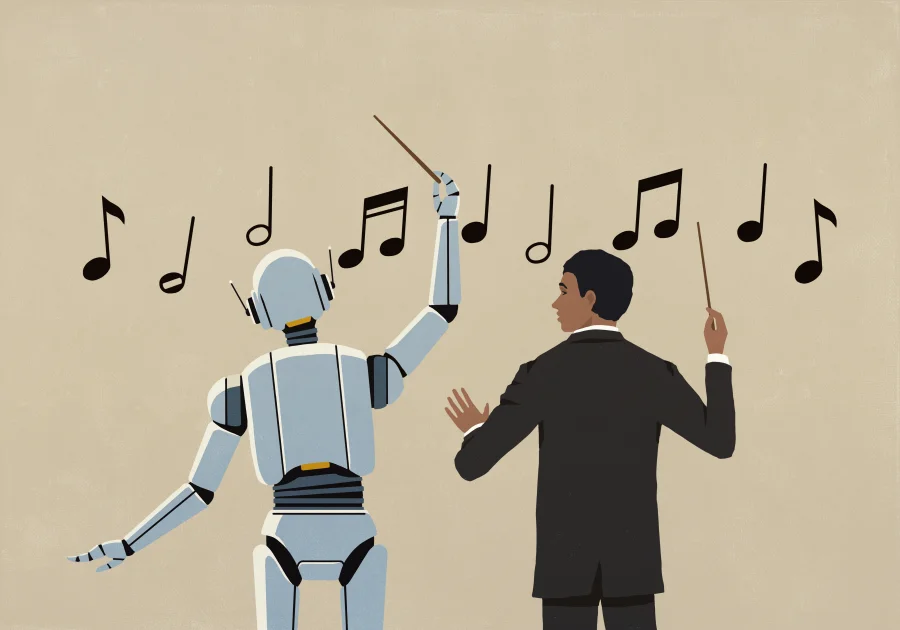
Photo credit: Malte Mueller, Getty Images
2 Comments
This is a rather meta task, to assign Chat to opine on AI. I agree, I also would have expected a more biased response. Perhaps it is a little ironic that ChatGPT provides an explanation that is contrary to its creator’s actions. Is this kind of impartiality what everyone should strive for? Or could there be some benefit to the various biases that humans hold?
I think your insight about how Chat GPT and other generative AI’s are only generating through patterns and not feelings is important. It’s one of the eerie things about Generative AI. Companies tell us that their AI’s “learn” and they respond to us almost like another human would, but they don’t have feelings or sides when it feels like if they were a human they should. I always feel like there are things it should be more opinionated about, but when it isn’t I question it’s usefulness because it’s largely reaffirming what I want to hear and it doesn’t always challenge that. Or if it does challenge me, unless it’s something factual, it’s easy for it to give in.